Creating lasting benefits for the communities around Black Law

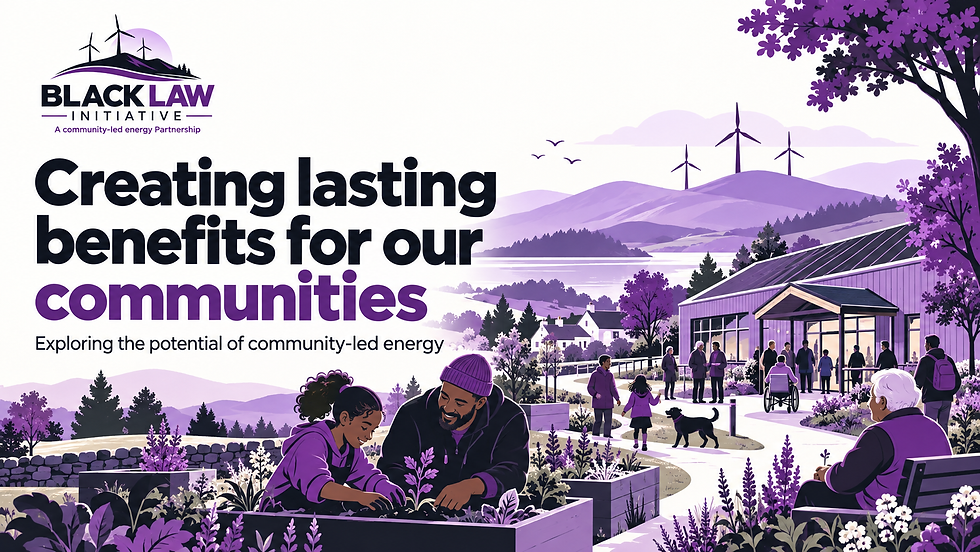
The Black Law Initiative is driven by a long-term ambition: to explore whether community participation in wind farm repowering could help sustain local services, strengthen community organisations and create opportunities for future generations.
Forth Development Trust and Soul of the Junction have established the founding partnership and are working to bring other local organisations into the conversation. Together, we want to investigate how more of the value generated locally could remain within our communities.
Achieving that will require a viable project, sound governance and a fair approach to sharing any future benefits.
Understanding where community value could come from
The opportunity concerns nine existing turbines on Forestry and Land Scotland’s Kingshill Plantation land, within the wider Black Law Wind Farm. The current lease expires in 2032.
Through FLS’s Community Access to Wind Repowering pilot, eligible communities have a dedicated opportunity to develop a request to lease the repowering site before commercial tendering. The Initiative is exploring how this opportunity might support a community ownership or partnership model.
The model chosen would affect the responsibilities communities take on, the risks they carry and the income they might receive. Direct ownership, a joint venture and other development partnerships therefore need careful assessment.
Any income available for community use would depend on the eventual agreements, electricity revenues, operating costs, borrowing and other financial commitments. We need professional feasibility and financial work before we can make credible estimates.
Starting with what communities need
Local organisations already work closely with residents. They understand the importance of accessible facilities, reliable services and opportunities for people of all ages.
Our project materials identify several potential uses for future community income, including:
Community buildings, facilities and local services.
Youth activities, skills and learning opportunities.
Community transport, health and wellbeing.
Local employment and regeneration.
Environmental projects.
Long-term grant support for community-led work.
These are areas to explore with participating communities. The coalition will need to establish priorities through consultation and agree how any future funding could make the greatest lasting difference.
A dependable source of income could help organisations plan further ahead, maintain facilities and develop services over time. That is an ambition worth investigating carefully.
Agreeing a fair approach
How future revenue might be shared is an important question, and one that deserves an open discussion.
The founding partners have identified fairness, proximity, population, community need, impact, transparency and long-term sustainability as principles for consideration. These provide a starting point for developing an approach with the wider coalition.
No revenue distribution formula has been agreed. Participating organisations are being invited to help shape the process, with consultation involving the communities they represent.
The intention is to develop a clear Community Benefit and Revenue Distribution Agreement. This should explain how decisions are made, how funds are allocated and how their use is reported.
Building accountability into the project
Community benefit depends on responsible decisions throughout the project’s development.
The coalition will need clear governance, appropriate professional advice and a legal structure capable of managing the project’s obligations. It must understand the risks before entering agreements and ensure that participating organisations have suitable protection.
As the work develops, communities should be able to understand what has been agreed, what remains uncertain and which decisions lie ahead. Clear reporting will help people assess progress and hold the project to its purpose.
Taking the next steps
The immediate work is to build the coalition, progress development funding and prepare the Note of Interest to Forestry and Land Scotland.
Alongside this, specialist advice will be needed on land rights, grid access, planning, environmental considerations, commercial arrangements and finance. These findings will help establish whether a deliverable project can support meaningful community returns.
The current lease expiry in 2032 is a key milestone. It does not establish when a future development would begin operating or when community income might become available.
The Black Law Initiative offers an opportunity to think beyond the next funding round and consider what could sustain our communities for decades. Our responsibility now is to test that opportunity thoroughly and build a partnership capable of pursuing it with care, fairness and a clear community purpose.


Comments